Pages

Showing posts with label earth inclusive tech. Show all posts

Monday, July 13, 2015

Orbital Data Centers

Cloud computing is the idea of storing data on a server or having that server perform tasks so there is less load on your computer. But these servers are located in warehouses on Earth. They require large amounts of energy, they have a large footprint, and they have to transmit data over a distance to your computer.  What if server farms were placed into orbit? What if cloud computing occurred above the clouds?

Orbital server farms would have several benefits to their terrestrial counterparts. The first is power. In orbit there is an abundant supply of solar energy, twice as much as what enters our atmosphere and hits the ground. It is also possible to be in continuous sunlight. This provides a clean and inexhaustible power supply for the farm.

Next, there is an abundant amount of space in space. A server farm may grow as large or larger than any building on Earth with.

Last, concerning transmission time, space really is halfway to anywhere. Today and in the future satellite transmission will be common. The trip up and then back down takes only millionths of a second but that is very slow for a computer which works with billions of operations per second. Halving the distance of transmission by just sending information down, instead of up then down, would increase internet speeds.

But that is a far rosier picture than reality. While endless solar power is available in orbit it would still require huge arrays to power a server farm. The ISS solar array is the size of a football field and provides 110 kilowatts of energy, enough to power 55 houses. But a 55,000 square foot server farm on Earth uses 5 megawatts or enough to power 5000 homes. Clearly a development in space power systems will need to be built. But computing is becoming more efficient all the time so such power requirements may not remain standard.

Next, indeed a server farm may grow as large as it wishes in orbit. But with increased size comes increased weight and therefore higher launch costs. The cost of space launches would have to become a thousand times cheaper than the cheapest SpaceX launcher existing today in order to compete with terrestrial installment. However initial launch costs may be offset if lifetime power costs were lower due to orbital solar plants.

Last, while internet and communication speeds may be twice as fast by placing the servers in orbit this may not be a significant enough trade-off for the risks of creating such a facility. But Google and others are working on using satellites to provide internet connectivity to the world, adding a few servers to the satellites is not a great leap.

But perhaps the biggest problem of all to such facilities may be cooling. Servers become very hot and require constant removal of heat. But in space there are few options for heat removal. Heat can only leave by radiation. But a satellite using solar power is also constantly absorbing heat as thermal radiation. If a satellite also has a hot server farm at its center then a substantial thermal management problem arises.

Despite those challenges here is why such data centers will exist. Just as Google and Facebook are trying to provide internet connectivity to places where there is none, so to do they need to provide data storage and computation. Second, having large power hogging facilities in orbit will reduce the load on Earth power plants and not be in danger of blackouts while using the Sun's energy. Last, if humans go to Mars they will need computing power. But it makes no sense to attempt to land servers on Mars when they can perform just as well in orbit and perhaps provide services to multiple settlements. The same goes for the Moon. The effort of landing a sever farm on another body is to great when it can just be parked in orbit.

The latter scenarios may be where orbital computing systems begin. Providing computing resources to future Mars missions. Small server farms requiring nothing on the scale of terrestrial data centers could be created and then launched to support space missions. This is something that already has many engineering precedents in places like the ISS. It a project which is well within current technologies to achieve and could actually be built by a small firm or just a few people in a garage. From there such orbital data centers could follow a modular growth plan where new, self-contained modules are continuously combined to create ever large server farms which are able to finally provide meaningful quantities of computation to the world or other colonies.

Data centers in space are something which have potential and are currently feasible. However in order to scale them to compete with existing data centers in a substantial way requires growth and construction of other space resources. However, small scale orbital server farms can be created to support missions to other planets which will be coming in the next decades. Whether they will ever replace their cousins on the ground on Earth is unknowable until the industry develops more.


Saturday, June 27, 2015

Space to Earth Delivery

Currently most of the effort in the space industry is toward getting things into space. However, there will come a time when we will be trying to bring more stuff down from space. Materials mined from asteroids, completed manufactured goods, finished experiments, and other products that were mined, grown, or made in space will require a means to bring them back down.

Intuitive Machines' TRV (Terrestrial Return Vehicle)
NASA has already begun addressing this problem. Intuitive Machines' Terrestrial Return Vehicle is being created and is intended to begin testing on the ISS in 2016. The purpose of the vehicle will be to provide a quick means to deliver time sensitive experiments safely back to Earth where further analysis can take place which can't occur on the space station. The design is expected to be launched from the station and then maneuver to and land at the nearest spaceport.

Delivery from space is a very viable business opportunity. Especially since commercial space stations, primarily from Bigelow Aerospace, are only a maximum of 5-10 years away. While NASA is taking the approach of creating a special vehicle for the task that is not the only method or business model.

A delivery company from space could begin as simply an organizer. Buying space on returning capsules for materials from other space stations. This would actually change the business dynamic of commercial launches, who's operation generally relies on only one ticket, round-trip or one way, to one customer. As traffic increases one organization can purchase the trip up but then someone else can reserve the trip down.

The reason NASA and Intuitive Machines are creating a single miniature craft for the task of delivery from orbit is schedule flexibility. Renting space on a capsule is fettered with the schedule of the capsule launch. But cargo, particularly experiments, may have expiration dates. The TRV ensures rapid delivery whenever needed. Just like Amazon, same-day delivery is the holy grail.

So what is required for a technology that drops things from orbit on command and lands them safely? This is dependent on the cargo. The TRV is a smal craft for deliverying small experiments. The small size allows for multiple craft to be delivered to the ISS in a single launch. The TRV is also outfitted with a maneuvering system. It is basically a complete small spaceship.

TRV being launched from the ISS
The complete spaceship design for the TRV is acceptable for the current state of the art and the amount of cargo transported. But as time passes completely disposable spaceships may be too expensive. An alternate method could be something along the lines of a space gun which launches small capsules of goods which are delivered from locations in orbit. This would eliminate the need for internal propulsion of the capsules and may simplify capsule design from lifting body to the more common tear-drop shape. Though such a system would not be required for several decades. Until inter-orbit transportation and exchange is common. Basically the "space gun" would be the post office and there would be mailmen going around orbit picking up "packages" and delivering them to the "space gun."

Concept for blanket used in asteroid retrieval in space
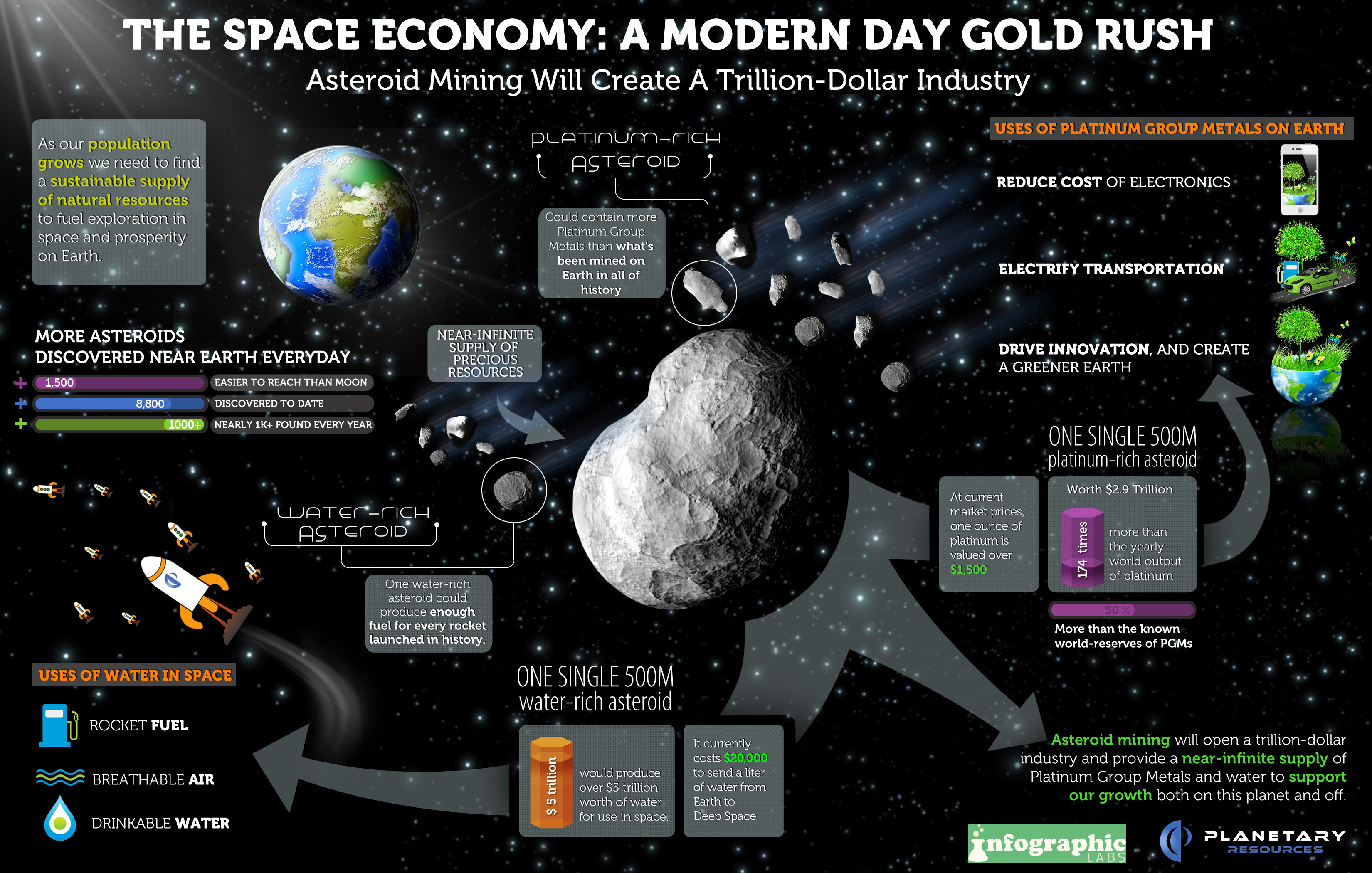
Going even a step further and considering asteroid mining. At some point the materials within those rocks will have to be delivered to Earth if they are to have any value. The trouble is that most asteroids burn up as they enter our atmosphere. A method will have to be devised for delivering these rocks safely to the surface so their contents can be collected and sold. Something along the lines of an ablative blanket could be created which protects the asteroids from the heat of reentry. (similar to how asteroid miners plan to protect water rocks from the sun's heat) Or perhaps large skeletal landers could be created which have a heat shield and a parachute. These landers could be filled with mined material or raw asteroids and landed, then, perhaps, even reused.

While all the focus as been on getting into space the need to send stuff back is growing everyday. The ISS needs to return experiments. Planetary Resources may need to land rocks. Private space stations may need to return manufactured goods. There may even be a need to send parts down to earth to be repaired and returned at the next launch of a capsule.

In order to develop an economy in space a two-way exchange between Earth and space must be set-up. Getting up there is great, but it matters little to the world unless something comes back.


Sunday, March 8, 2015

Space Burial

One of the more interesting space businesses, which is really as old as spaceflight itself, is the idea of space burials.

As a means of disposing of the deceased space burials are actually quite practical and even more emotional. Leaving someone in a place where they will perpetually drift and travel and perhaps even seed life into arid worlds, is a very romantic way to send them on to the next life.

Space burials have been going on since the very first moon landers. Ashes of people have been sent up ever since. Celestis, Inc is a company that has formed around the idea of space burial. Celestis purchases empty space on launches and fills them with samples of cremated remains. The people that have been buried in space include Gene Roddenberry, the creator of Star Trek, as well as several hundred other people.

However, at this point a typical space burial includes less than an ounce of ashes in a sample tube which take the ride, but then typically come back down as the orbit decays or the mission ends. Very few people have had remains placed permanently into space. And certainly, there have been no full bodies sent, only cremated remains.

Space burials as a business, are actually very simple. A basic set of vials are made and ashes inserted. Then they are placed in an empty corner of the next possible launch. Low weight, low effort, but a very moving way to be buried.

In future space burials will no doubt become much more commonplace. While they are currently reserved for rich and famous, as launches become ever more frequent so will the space to place the small caskets. Someday entire bodies may be buried in space. Though there will no doubt be restrictions on this practice to ensure that tourists in orbit are not surprised by a cadaver outside of the station.

Space burials will also grow to be much more than a typical burial. They may come to epitomize the ideals of space travel. Imagine an astronaut or scientist dedicating their entire life to space but dying before their dream was realized. Perhaps they wanted to reach an asteroid or set foot on Mars. Placing to sending their remains to those places fulfills and legitimizes their life's work and can inspire others to follow.

Space burials are likely one of the oldest commercial space businesses and will likely remain after many others die.  While at this moment they may seem a bit sterile compared to a casket and flowers, they are far more meaningful and beautiful. Space is an eternity, why not place a person's remains in eternity after they have entered it.

Saturday, May 17, 2014

Astronaut Camps

"Live a week like an astronaut."

A company that puts people through rigorous astronaut training and simulations. This business can be approached from both the experiential entertainment/learning side or the serious launch preparation side.

This business could begin as space camp on steroids. Just like when some people take nature survival classes or mock SEAL training, this "camp" could create the experience of training for and being an astronaut. People could go through zero-g flights, centrifuges, and all kinds of tough workouts. Then, after a time of "training" they would be able to be put into the simulation of their choice. Perhaps 'repair' a space station mock-up in the swimming pool, or visit the "Mars Colony" on campus.

Of course, it doesn't have to take such an extreme direction. Creation of the experiences of being on Mars or the Moon for a week as if one were a real astronaut (an extreme space VR) could also be a viable business model on the entertainment side.

Such a camp could also become the industry contractor for preparing prospective space tourists and explorers for their launches and missions. It would be in charge of training and certification of most space passengers in the weeks prior to their flights. Currently, this is performed by the launch company. Being able to outsource passenger preparation would allow those companies to focus on their primary business of engineering vehicles.

Space Camps and "learning to be an astronaut" has been around for awhile. And companies like Zero-G are capitalizing on people wanting to have a space experience. The problem is that space camps have been relatively superficial and don't capitalize on the complete experience. And Zero-G is focusing only on the weightless flights. A true Astronaut camp would need to go deeper into the experience and leverage all connections with companies like Zero-G and others like it that will emerge.

Now there is always the danger that the entertainment or learning aspect of the camp will not get the response needed to maintain it. It will have a marketing and presentation problem. After all, space doesn't quite have the attraction that it did in the 1950's-1970's. But if that should fail initially, the entertainment concept could be kept in reserve for when space opens up again and public interest is in that direction. Until then, contracts for actual training for missions would be adequate and increasing as more launch vehicles begin operations and human traffic increases.

This kind of a business has a lot of facets. Practical, leisure, extreme sports, team-building. An "Astronaut Camp" could take any kind of form or focus. If it is to cater to the general public it would have to be something fun and exciting that isn't too harsh but still give the real feel for space. But if it wants to be a part of the actual private space industry, in a big way, it will need to eventually become what some of Nasa's Manned Spaceflight Centers are.

But overall, the idea of an all-in "Astronaut Camp" is something that can be approached today and, with proper execution, could be viable independently of the current space industry.

Tuesday, April 15, 2014

Space Board Games

The creation of tabletop/board games for the zero-gravity of space.

As space tourism and colonization begins to grow and progress the customs and pastimes of the people that spend time in space will also morph from what we know on Earth. This creates an opportunity for inventors and entrepreneurs imagine and create things that can add to that society today.

In our digital world board games still have a strong hold of the way people spend their time. Games like chess and checkers have existed for hundreds of years. But they are all terrestrial.

In space new games can be created that function very differently from those on Earth. Space has the unique quality of no gravity. Games that were once played on a two-dimensional board can now be played in three-dimensional space.
Spock playing Three-Dimensional Chess

These games will be needed. The space tourists will want every indulgence in order to make their space experience a full one. This requires activities that can only be performed in space. Space games will have to be created as these resorts and cruise lines begin to be created.

And those colonists that will have a six month journey on their way to Mars or some other colony will need to have something to pass the time. A good board game is far more physically interactive and connecting than a computer game. Such games can literally help to keep crews sane on these long journeys.

The design of these games can be varied. Some may simply be standard Earth games with the pieces adapted for the space environment. Something like added magnets to keep them from floating around. Pretty easy to do

Perhaps games can be designed to have psychological benefits from the crew using them. Something along the lines of trivia games using particular images of Earth to encourage "happy thoughts" in the crew.

And of course, entirely new games can be created that are designed singularly for space. Games that may actually start in space and eventually be implemented on Earth. These creates an entirely new spectrum of game design that can begin to be explored.

This little piece of entertainment, the board game, that has been common on Earth can easily be made common in space. It is one of those ideas that requires little capital to create in an industry which is generally extremely expensive today.

Friday, April 4, 2014

A Space Holodeck

Extended time spent in space can have any number of psychological affects on space crews. Being locked inside a metal can with absolutely nothing outside and no one to help if there is a problem will wear on anyone. Not to mention the endless boredom and routine. While a spaceship will need constant supervision there will never be enough to do on a 2-3 year mission to Mars and back. Crews will need some form of entertainment. But not just movies and books. The crews of long duration spaceflights need something to connect them with home. Something that will give them a reprieve from the isolation of space. Luckily, movie-makers and futurists have already created such a device. The Holodeck.

The "Holodeck" of science fiction is a virtual reality (VR) room that becomes completely interactive. The user becomes a part of a different world ,which they can see and interact with using all of their senses. In science fiction the holodeck experience is accomplished through "hard light." No such technology exists today. However limited virtual reality is starting to gain significant traction in the video game industry. Products like the Kinect and the Oculus Rift insert the player into the game they are playing.  The Oculus Rift creates the illusion of being in the game through a pair of video goggles that let the user see the environment of the game as if through the eyes of their character. They move their head to the left they see the left and vice-versa. Goggles like the Rift can also be interfaced with treadmills and devices, like the Kinect, that track the users body movements. This allows the user of these complete systems to interact with the game using their entire body, running, jumping, and shooting just as if they were actually doing it. But these systems currently only let the user interact with the game and not the game with the user. Players can't feel the recoil of a gun or smell the smoke, they can only move around in it. And yet that may be all that is needed for space.


While the VR systems of today are designed for gaming they could easily be turned into a means of remaining connected with Earth. Systems very similar to the one shown above could be installed on future spaceships. Then, when astronauts go for a jog, instead of simply looking at a wall while they run on the treadmill, they can put on the goggles and immediately be transported to the edge of the Grand Canyon. They would be able to see the sunrise and, for just a little while, feel as if they have the entire Earth underfoot instead of being thousands of miles away from it. This can have tremendously positive affects on the crew.

A company that would want to pursue this type of technology would need to develop two things. First they would need to create a complete VR system that tracks the user and lets them interact with their environment. This has already been accomplished, so most of the focus would be on the second part. Creating the virtual environments from video gathered on Earth.

The company would need to create a means to make a video, of say a jog along the Grand Canyon, interactive. The user of the video would need to be able to "stop and smell the roses"  without having to pause the video. This will require a means of layering panoramic video from multiple cameras and syncing it perfectly. This hasn't been accomplished in the VR industry yet. The standard graphics for VR today are mostly CGI because it is easier to create a VR environment within a fake world.  But they look clunky and plastic. While these would have their place in entertainment for future space travelers, they would not have remotely the same effect as a true interactive image of home.

However, it is possible that, in creating these interactive environments that can't be touched or smelled, the experience could create the reverse of hope. It could bring about desperation from seeing something so real and not being able to feel it. It could be the equivalent of seeing a mirage of water when you are thirsting in the desert. There are too few studies available today to know what kind of effects this technology would have. A company interested in space applications would need to explore the affects thoroughly once created.

The major benefit to a company that creates these future space "holodecks" is that they would be a company that is not limited to the space industry. Many people on Earth want to have the visual experience of a jog on a beach in Madrid or along the Grand Canyon, instead of watching the morning news on their treadmill. And there would be no psychological implications from this type of technology in this situation. It would become a perfect example of advancing terrestrial life while developing products for space.

The company to create a viable environment that really becomes believable, though untouchable, will be one of the leaders of the future VR market. But it may also be able to solve half of the psychological problems associated with the long term isolation associated with current interplanetary spaceflight.